China, 30th Jun 2026 – Global social media operations are undergoing a structural transition from content-centric execution models toward infrastructure-driven growth systems, as rising customer acquisition costs, tightening platform governance, and increasing operational complexity reshape how cross-border teams scale digital acquisition.
According to cross-border trade monitoring by the World Trade Organization (WTO) and market intelligence from Statista, global digital advertising costs across major ecosystems including TikTok, Meta, and Google have continued to rise steadily over the past several years, with cost-per-acquisition (CPA) in competitive verticals increasing by an estimated double-digit percentage annually in multiple regions. At the same time, platform governance frameworks have become significantly more strict, particularly in relation to multi-account behavior, device-level fingerprinting, and identity consistency enforcement.
These structural changes are driving social media operations beyond traditional content production and media buying workflows. Instead, enterprise teams are increasingly required to build scalable operational infrastructures capable of supporting distributed account networks, cross-time-zone execution, and multi-platform coordination across TikTok, Instagram, Facebook, and WhatsApp ecosystems.
PMOCK Cloud Phone, a cloud-based mobile infrastructure provider, reported growing adoption of its virtualized device system among cross-border e-commerce operators, digital marketing agencies, and enterprise social media teams managing large-scale account matrices. The company stated that demand is being driven by increasing operational instability in traditional device-based workflows, as well as rising requirements for compliance-aligned, scalable, and geographically distributed operational environments.
Industry analysts describe this shift as the emergence of “growth infrastructure engineering,” where competitive advantage is no longer defined solely by content output or advertising budget, but by the stability and scalability of underlying operational systems. In this context, infrastructure is becoming a core determinant of revenue continuity and account survivability in high-volume digital marketing environments.
As global teams expand toward matrix-based social media operations, platform risk detection systems have become significantly more sophisticated. Current mechanisms increasingly rely on IP fingerprinting, device-level hardware signatures, behavioral patterns, geo-location consistency, and login session correlation to assess account relationships.
In practice, many teams still depend on traditional operational methods such as physical device farms, proxy switching, or emulator-based environments. These approaches, however, often introduce instability into large-scale operations. Account clustering risks remain difficult to control, and when detection is triggered, cascading bans across linked accounts can occur. In addition, maintaining consistent IP governance across multiple regions adds further operational complexity.
For high-growth scenarios such as TikTok Shop or Meta advertising campaigns, even a single association failure can disrupt an entire cluster of revenue-generating accounts, particularly during peak traffic cycles.
As account scale increases, social media operations typically evolve into multi-layered systems involving TikTok content matrices, Instagram seeding accounts, Facebook ad structures, and WhatsApp-based conversion workflows. However, many teams still rely on a device-centric manual workflow model.
This often includes repeated login and logout across accounts, spreadsheet-based tracking systems, and shared device usage among team members without standardized access control. As a result, operational inefficiencies become more pronounced. Execution errors increase, auditability becomes limited, and governance structures remain underdeveloped.
For enterprise-level cross-border organizations, these coordination frictions gradually translate into structural limitations on growth scalability.
At its core, social media growth is still driven by content throughput. However, as account matrices expand, content production systems often fail to scale at the same pace.
Short-form video production costs continue to rise, while localization requirements across languages and regions add further complexity. At the same time, content formatting standards differ across TikTok, Instagram, and Facebook, making cross-platform adaptation more resource-intensive. Most teams also face limitations in creative bandwidth, particularly when operating with fixed in-house production resources.
Industry benchmarks suggest that high-performing TikTok accounts often require multiple content outputs per day to maintain algorithmic visibility. When scaled across dozens or even hundreds of accounts, the demand quickly exceeds the capacity of traditional creative teams, creating a persistent imbalance between account scale and content supply.
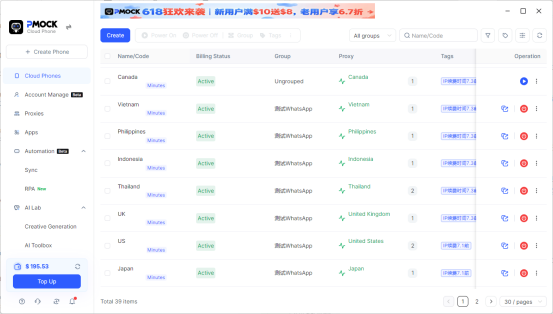
Against this backdrop, cloud-based mobile infrastructure solutions such as PMOCK Cloud Phone have emerged as part of a broader shift toward system-level operational architecture in global social media management.
Its design logic is centered on combining isolated mobile environments with automation and distributed cloud nodes, enabling teams to move from fragmented execution toward more structured operational systems.
The system is built on an ARM-based virtualization architecture that provides independent mobile environments for each instance. In practice, each account operates within its own isolated device environment, with separated system parameters and encrypted configuration structures.
This one-to-one mapping between account, environment, and IP reduces cross-account interference and helps teams maintain clearer operational boundaries. Compared with traditional emulator or shared-device setups, this approach aims to simulate more consistent mobile device behavior at the system level.
The platform also integrates multiple global cloud nodes, allowing teams to align account environments with different regional markets such as North America, Southeast Asia, and Europe. This supports geographically consistent operational setups across distributed teams.
Content production is increasingly being integrated into operational infrastructure rather than treated as a separate creative function. Within this system, AI-assisted tools are used to generate product visuals, short-form video materials, and cross-platform content adaptations.
This integration allows teams to reduce dependency on external production pipelines and shorten content iteration cycles. In some cases, brands in fast-moving categories such as beauty and fashion have shifted from traditional production workflows to AI-assisted content generation processes, significantly reducing turnaround time for creative assets.
While adoption levels vary across industries, the broader trend reflects a move toward more automated and modular content production systems.
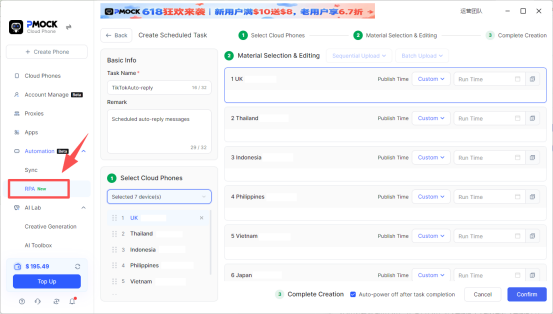
As global campaigns expand across markets, execution timing has become a critical operational factor. To address this, automation tools are increasingly being used to schedule and coordinate cross-time-zone posting activities.
In practice, teams are able to predefine publishing schedules, automate repetitive engagement actions, and coordinate multi-account deployments without manual intervention. This reduces dependency on continuous human monitoring and enables more consistent traffic generation across different regional peak hours.
For larger organizations and agencies, governance has become a key requirement alongside scalability. Role-based access control, operational logging, and environment segmentation are increasingly being integrated into social media infrastructure systems.
These capabilities allow enterprises to define clearer operational hierarchies, track account-level activities, and reduce ambiguity in multi-team collaboration environments. As platform compliance requirements continue to tighten globally, structured governance is becoming a necessary component of scalable operations.
The evolution of social media operations is increasingly defined by system integration rather than isolated tactical execution. Account security, content production, automation, and compliance management are gradually converging into unified operational infrastructures.
In this context, platforms such as PMOCK Cloud Phone are positioned within a broader industry shift toward infrastructure-based growth models. The competitive focus is no longer limited to content output alone, but extends to the stability, automation depth, and governance capability of the underlying operational system.
As cross-border commerce continues to mature, the companies that achieve sustainable growth are likely to be those that can build more resilient and scalable social media infrastructures, rather than those relying solely on content volume or manual execution capacity.
Media Contact
Organization: MOCK INFORMATION TECHNOLOGY LIMITED
Contact Person: Congcong
Website: https://pmock.com/
Email: Send Email
Contact Number: +8613159229764
Address:ROOM C03 9/F KATOFACTORYBUILDING 2 CHEUNGYUE STLAI CHI KOKKL
Country:China
Release id:46504
The post Global Social Media Teams Shift to Infrastructure-Driven Growth as PMOCK Adoption Expands appeared first on King Newswire. This content is provided by a third-party source.. King Newswire makes no warranties or representations in connection with it. King Newswire is a press release distribution agency and does not endorse or verify the claims made in this release. If you have any complaints or copyright concerns related to this article, please contact the company listed in the ‘Media Contact’ section

Disclaimer: The views, suggestions, and opinions expressed here are the sole responsibility of the experts. No Thinker Now journalist was involved in the writing and production of this article.